

The ASTROLENS 1.0 astrophotography contest has officially concluded, and we extend our heartfelt gratitude to every participant who shared their vision of the night sky. From sweeping Milky Way panoramas to intricate deep-sky captures, your submissions have illuminated the beauty of the cosmos above Bangladesh.
We are proud to celebrate the winners across both categories:
- Amateur Category – showcasing wide-angle wonders and inspiring creativity.
- Professional Category – revealing the distant galaxies, nebulae, and planets with remarkable technical mastery.
Congratulations to all our winners! Your artistry and dedication not only highlight the breathtaking universe but also elevate the growing culture of astrophotography in Bangladesh.
Professional Category

In the Professional Category, we celebrate the astrophotographers who have taken us far beyond the horizon. These winners turned their lenses toward galaxies, nebulae, and planets, capturing the distant cosmos with remarkable skill and vision. Their work blends technical precision with artistic creativity, reminding us how vast and beautiful the universe truly is. Each image is a testament to the dedication and passion that keep astrophotography thriving in Bangladesh.
WINNER

Ashikur Rahman Ratul
Andromeda (M31), our closest galactic neighbor, captivates with its brilliance within the Andromeda constellation, residing approximately 2.5 million light-years away. Under the cloak of dark, expansive skies, this celestial marvel stretches across an area nearly six times the apparent width of the full Moon. Homing more than a trillion stars, it’s engaged in a slow, cosmic dance, steadily moving towards the Milky Way, with a projected merger anticipated in approximately 4 billion years. While to the unaided eye, it might just seem like a subtle, faint gray smudge, the true artistry of astrophotography unfolds through extended exposures and meticulous processing, revealing its vibrant colors and intricate structures – truly the heart of astrophotography. Here are some technical details: The equipment used includes an Askar 71F telescope with a focal length of 490mm, and a Canon 6D (Stock DSLR) camera. The total exposure time was 7 hours. Stacking was done using DeepSkyStacker, and the images were processed with PixInsight and Photoshop. The location was Moscow, Idaho, USA, with a Bortle scale rating of 5.
1st RUNNERS UP

Rezaur Rahman Hasib
Captured under the heavy light pollution of Dhaka’s Bortle Class 9 skies, this image reveals the stunning contrast between the Great Orion Nebula (M42)—a massive stellar nursery over 1,400 light-years away—and the neighboring Running Man Nebula (NGC 1977). Achieving this level of detail required roughly 1.5 hours of total exposure time, compiled from 219 light frames at 25 seconds each, managed by a modified Canon 600D and a 250mm lens mounted on a DIY star tracker. To combat the urban glare and sensor noise, a full calibration suite of 36 darks, 52 flats, and 52 biases was used, with the final data meticulously refined through a processing workflow of Siril, GraXpert, and Adobe Photoshop.
2ND RUNNERS UP

Ankit Biswas
Located in the darker, more forgiving Bortle 4 skies of Patuakhali, Barishal, this capture of the Pleiades star cluster (M45) highlights the impressive results possible with manual tracking. Using a Canon DSLR at a 75mm focal length, the photographer gathered 11 minutes of total exposure at ISO 1600, revealing the delicate blue reflection nebulosity surrounding the “Seven Sisters.” The final image was brought to life through a focused post-processing workflow involving Sequator for stacking, followed by refinement in Siril and GIMP to balance the celestial highlights and deep-space shadows.
Amateur Category

The Amateur Category celebrates the passion and curiosity of those who turned their cameras toward the night sky for the sheer joy of discovery. From wide‑angle views of the Milky Way to peaceful nightscapes, these winning photographs capture the wonder of stargazing in Bangladesh. Each image reflects not only the beauty above us but also the creativity and dedication of photographers who remind us that anyone, with patience and imagination, can bring the universe a little closer.
WINNER

Nahin
Framed by the intricate silhouette of overhanging branches, this “Walking the Lunar Path” composition was captured in the Bortle 6 skies of Dhaka, Bangladesh. Utilizing a Pixel 6 Pro, the shot relies on a 5-second shutter speed at ISO 100 to maintain crispness and minimize noise in the night sky. The final ethereal effect was achieved through a double exposure technique within Snapseed, blending the lunar focus with the natural textures of the foreground to create a balanced, atmospheric scene.
1st RUNNERS UP

Muhammad Saidul Islam
Captured under the pristine, ink-black skies of Saint Martin—a rare Bortle Class 1 location—this wide-angle view of our cosmic home highlights the incredible scale of the Milky Way. Utilizing a Sony A6000 paired with a fast 16mm f/1.4 lens, the image combines a total exposure time of 130 seconds at ISO 2500 to reveal the warped, twisted disk of our barred spiral galaxy and its dense population of up to 400 billion stars. The data, which includes the glowing core where the supermassive black hole Sagittarius A* resides, was expertly stacked in Sequator and finished with refined color and contrast adjustments using Adobe Photoshop and Lightroom.
2ND RUNNERS UP

Ankit Biswas
In this striking composition titled “The Ultimate Highway; Destination: Infinite,” the ethereal beauty of the Milky Way is perfectly aligned with a desolate, sandy path in Kuakata. Captured under the clear Bortle Class 3 skies of coastal Bangladesh, this image utilizes a sophisticated blend of exposures taken with a OnePlus 10R. The foreground features a 20-second single exposure to ground the scene, while the celestial background was built from 15 minutes of total exposure time to reveal the vibrant core of our galaxy. The final result was seamlessly merged and stacked in Sequator, with technical color and light refinements performed in Siril and GIMP to create a truly immersive cosmic landscape.
3RD RUNNERS UP
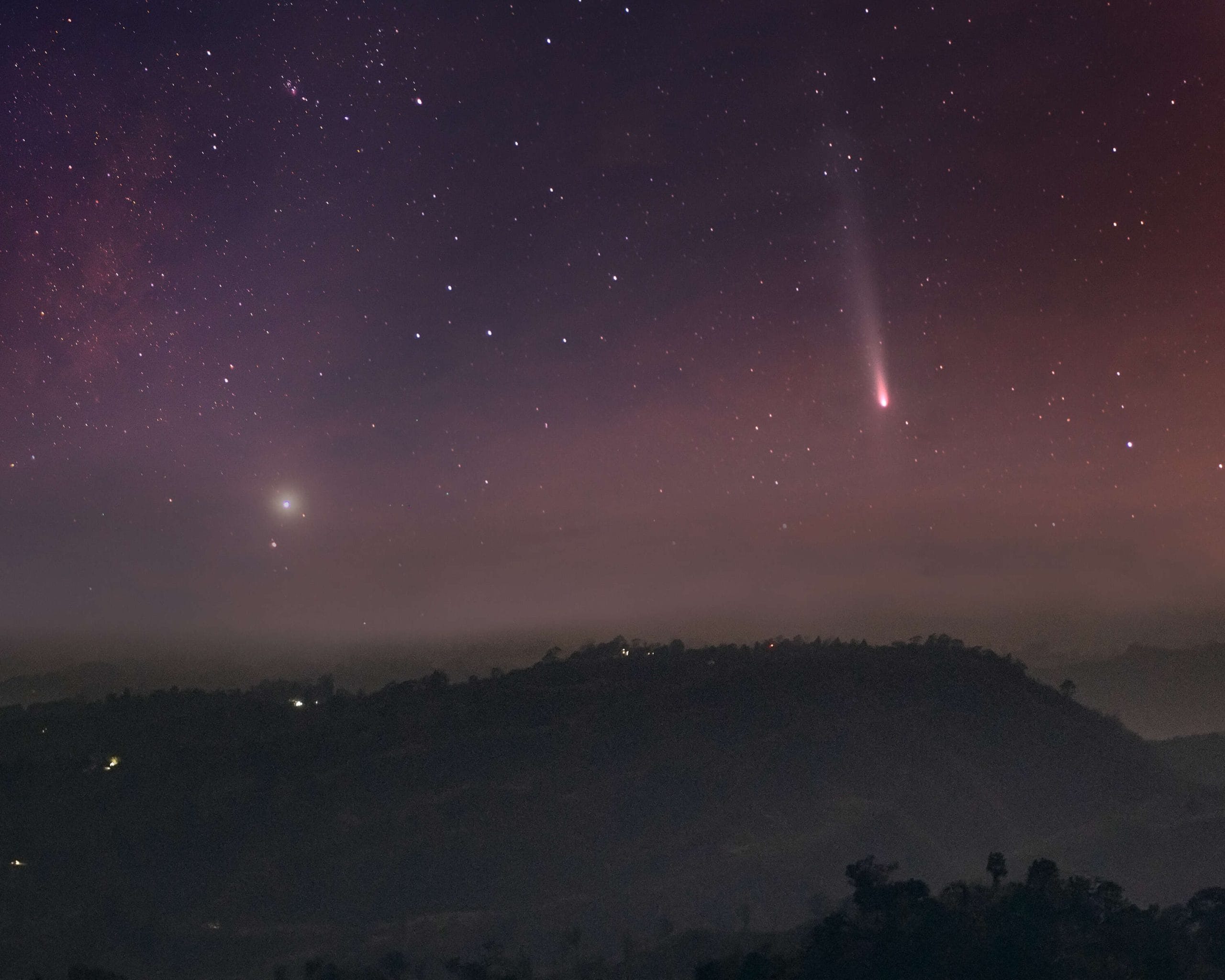
Rafi Mahmud
This rare celestial gathering captures the comet C/2023 A3 (Tsuchinshan–ATLAS) alongside a brilliant Venus and the faint glow of the Galactic Core. Photographed with a classic Canon 60D and a “nifty fifty” 50mm f/1.8 lens, the image is a technical blend of two worlds: a single exposure preserves the natural positioning of the Milky Way and Venus, while a stack of 83 light frames pulls out the intricate, streaming detail of the comet’s tail. Despite the loss of the original raw files due to storage constraints, the final render serves as a stunning high-resolution record of this unique cosmic alignment.
4TH RUNNERS UP

Nakib Ifsan
In this evocative composition titled “Walking Towards The Sweet House,” the night sky over Bogura, Bangladesh, is transformed into a vibrant tapestry of deep-space wonders. Captured with a Nothing Phone 3A at a 50mm focal length, this image is a testament to the power of modern mobile astrophotography under Bortle Class 4 skies. The frame is densely packed with iconic celestial landmarks, including the Orion, Running Man, Flame, and Rosette Nebulae, alongside the faint, sprawling curves of Barnard’s Loop and the Witch Head Nebula. Bright stars like Betelgeuse and Rigel anchor the scene, while extensive H-alpha gas regions glow with a haunting red hue. Achieving this level of clarity required 45 minutes of total exposure at ISO 6400, followed by a rigorous processing workflow involving Sequator, Siril, GraXpert, Adobe Photoshop, and Lightroom to balance the terrestrial foreground with the infinite cosmic backdrop.